|
"Torreya, a Tree with Possibilities" by Winton H. Reinsmith
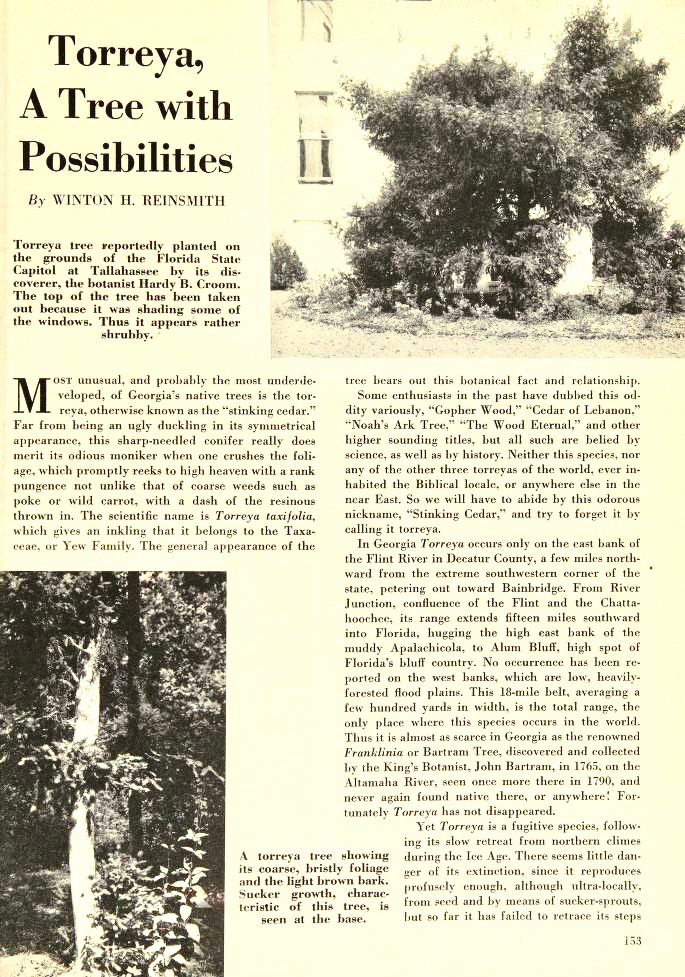
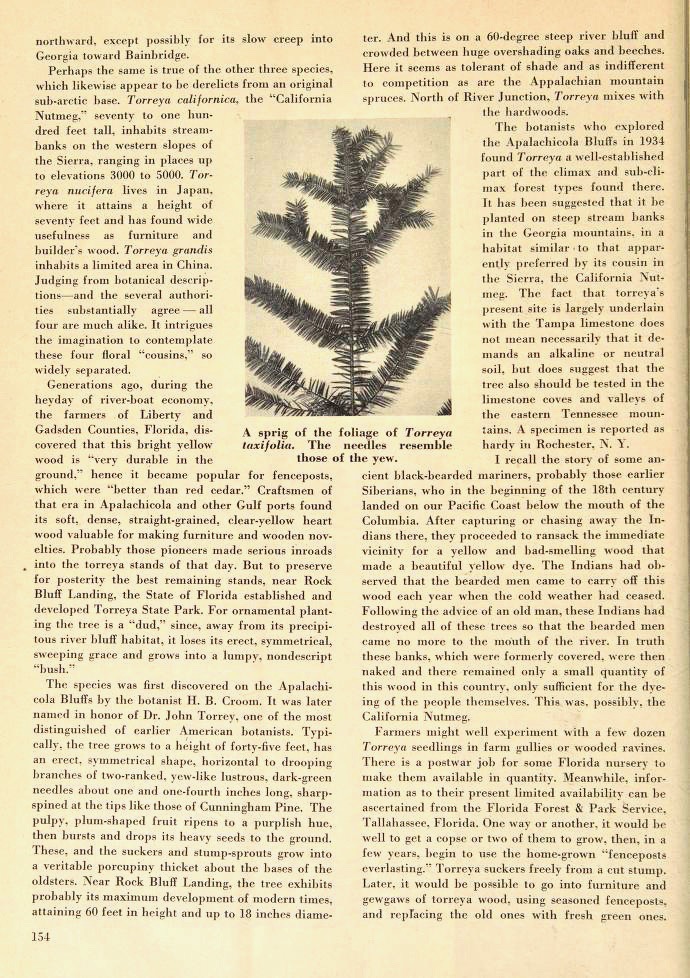
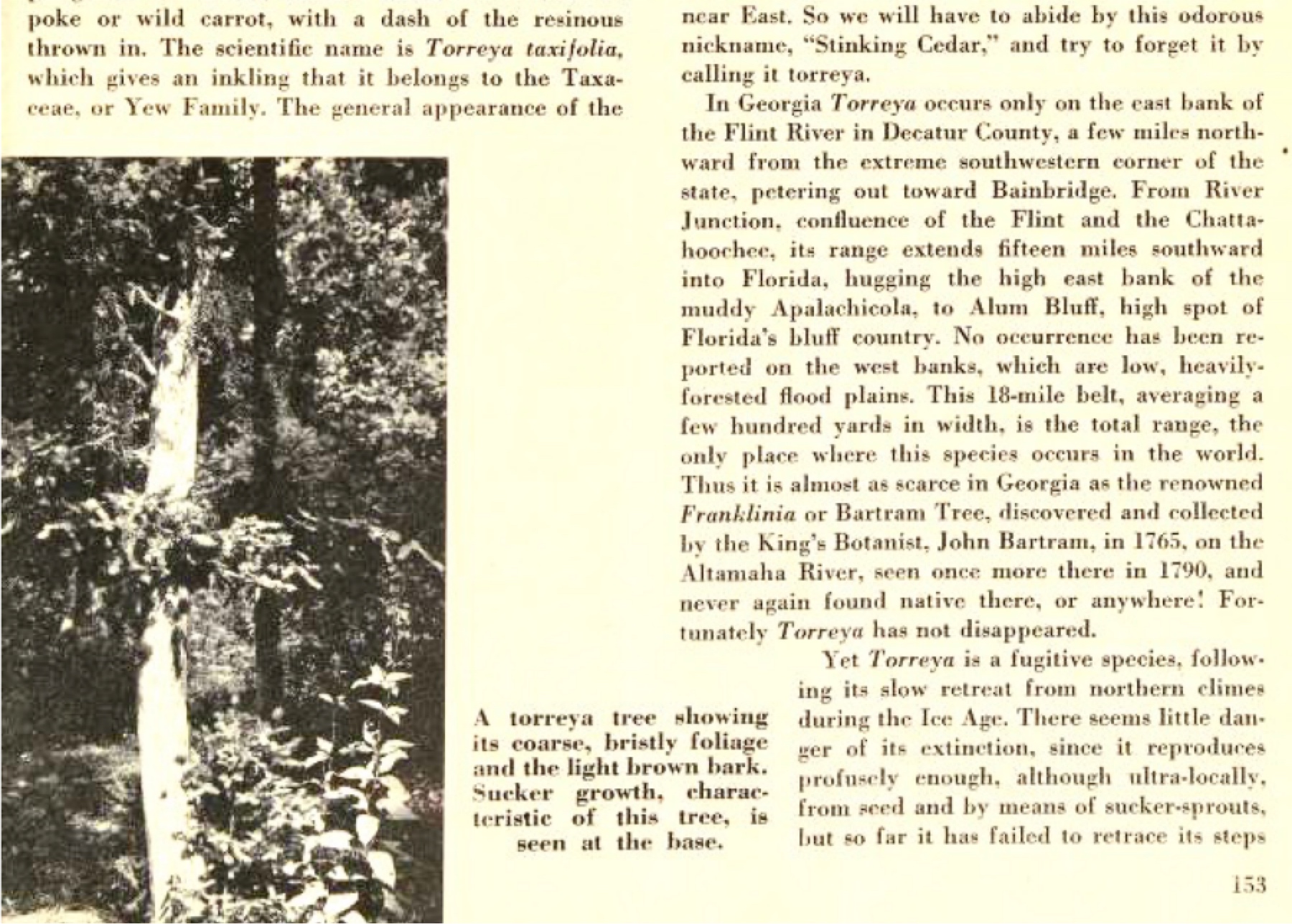
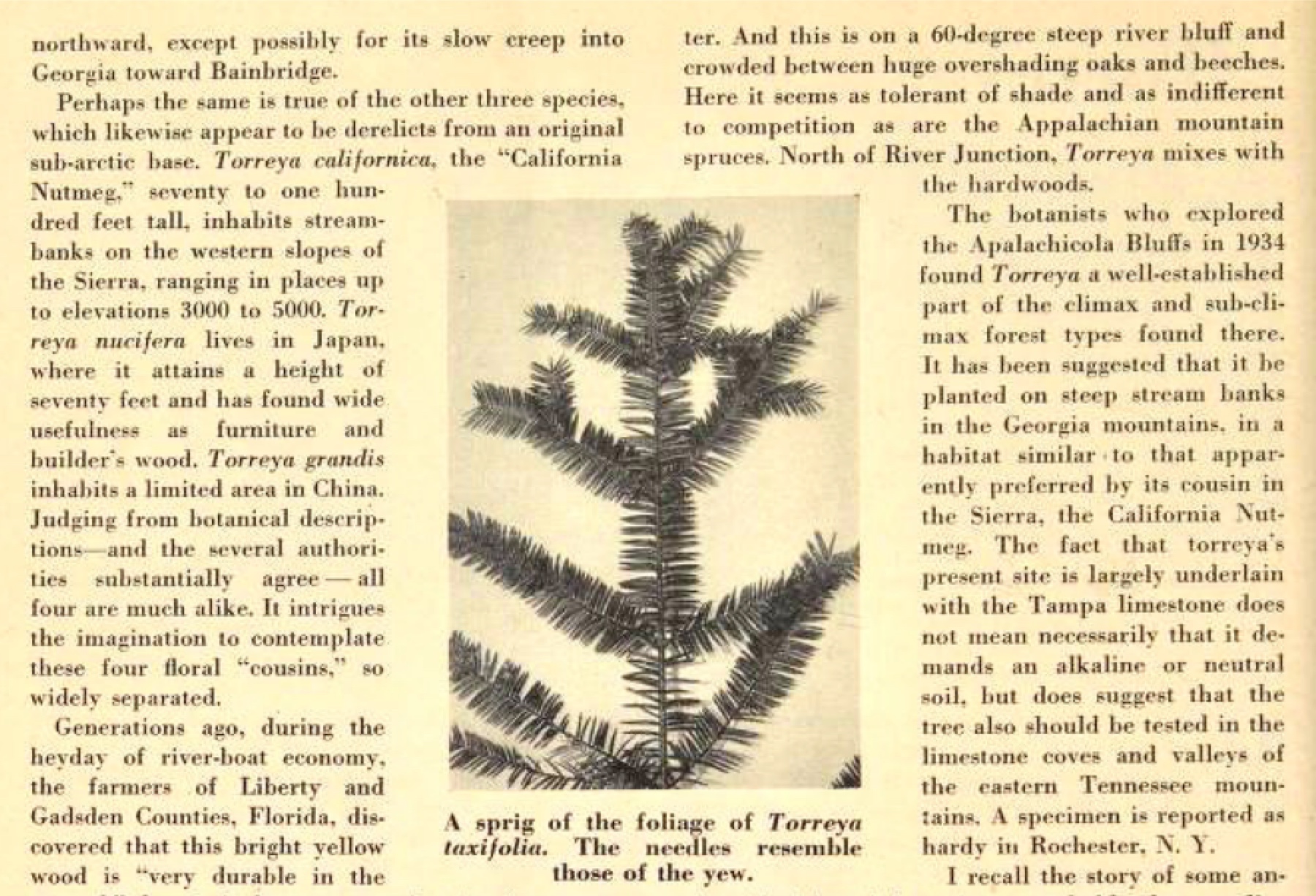
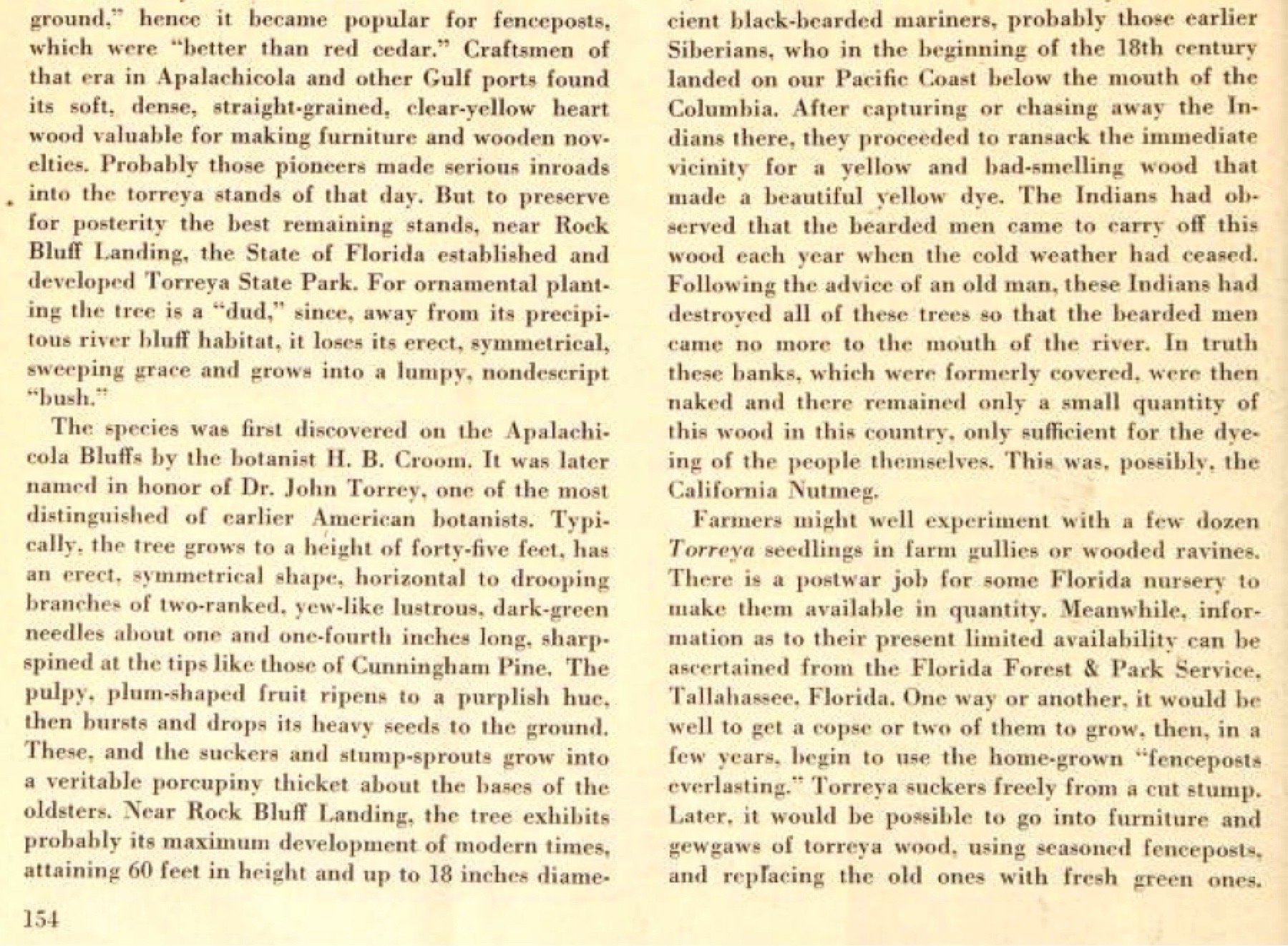
In 2026 Paul Camire, a Torreya Guardian in Michigan, discovered this archived article online. Expanded images of the article are shown at bottom. But first, I excerpt almost all of the article and add bold (and color) to draw attention to key points. Much of the excerpted text also appears on these additional pages on the Torreya Guardians website, as it offers crucial historical, cultural, and ecological understandings of this endangered tree that are not available in any academic publications: Yet Torreya is a fugitive species, following its slow retreat from northern climes during the Ice Age. There seems little danger of its exinction, since it reproduces profusely enough, although ultra-locally, from seed and by means of sucker-sprouts, but so far it has failed to retrace its steps northward, except possibly for its slow creep into Georgia toward Bainbridge. Perhaps the same is true of the other three species, which likewise appear to be derelicts from an original sub-arctic base. Torreya californica, the "California Nutmeg," seventy to one hundred feet tall, inhabits stream-banks on the western slopes of the Sierra, ranging in places up to elevations 3000 to 5000. Torreya nucifera lives in Japan, where it attrains a height of seventy feet and has found wide usefulness as furniture and builder's wood. Torreya grandis inhabits a limited area in China. Judging from botanical descriptiions — and the several authorities substantially agree — all four are much alike. It intrigues the imagination to contemplate these four floral "cousins," so widely separated. Generations ago, during the heyday of river-boat economy, the farmers of Liberty and Gadsden Counties, Florida, discovered that this bright yellow wood is "very durable in the ground," hence it became popular for fenceposts, which were "better than red cedar." Craftsmen of that era in Apalachicola and other Gulf ports found its soft, dense, straight-grained, clear-yellow heartwood valuable for making furniture and wooden novelties. Probably those pioners made serious inroads into the torreya stands of that day. But to preserve for posterity the best remaining stands, near Rock Bluff Landing, the State of Florida established and developed Torreya State Park. For ornamental planting the tree is a "dud," since, away from its precipitous river bluff habitat, it loses its erect, symmetrical, sweeping grace and grows into a lumpy, nondescript "bush." The species was first discovered on the Apalachicola Bluffs by the botanist H.B. Croom. It was later named in honor of Dr. John Torrey, one of the most distinguished of earlier American botanists. Typically, the tree grows to a height of forty-five feet, has an erect, symmetrical shape, horizontal to drooping branches of two-ranked, yew-like lustrous, dark-green needles about one and one-fourth inches long, sharp-spined at the tips like those of Cunningham Pine [Cunninghamia, an Asian genus]. The pulpy, plum-shaped fruit ripens to a purplish hue, then bursts and drops its heavy seeds to the ground. These, and the suckers and stump-sprouts grow into a veritable porcupiny thicket about the bases of the oldsters. Near Rock Bluff Landing, the tree exhibits probably its maximum development of modern times, attaining 60 feet in height and up to 18 inches diameter. And this is on a a 60-degree steep river bluff and crowded between huge overshading oaks and beeches. Here it seems as tolerant of shade and as indifferent to competition as are the Appalachian mountain spruces. North of River Junction, Torreya mixes with the hardwoods. The botanists who explored the Apalachicola Bluffs in 1934 found Torreya a well-established part of the climax and sub-climax forest types found there. It has been suggested that it be planted on steep stream banks in the Georgia mountains, in a habitat simlar to that apparently preferred by its cousin in the Sierra, the California Nutmeg. The fact that torreya's present site is largely underlain with the Tampa limestone does not mean necessarly that it demands an alkaline or neutral soil, but does suggest that the tree also should be tested in the limestone covers and valleys of the eastern Tennesseee mountains. A specimen is reported as hardy in Rochester, N.Y. I recall the story of some ancient black-bearded mariners, probably those earlier Siberians, who in the beginning of the 18th century landed on our Pacific Coast below the mouth of the Columbia. After capturing or chasing away the Indians there, they proceeded to ransack the immediate vicinity for a yellow and bad-smelling wood that made a beautiful yellow dye. The Indians had observed that the bearded men came to carry off this wood each year when the cold weathr had cased. Following the advice of an old man, these Indians had destroyed all of these trees so that the bearded men came no more to the mouth of the river. In truth these banks, which were formerly covered, were then naked and there remained only a small quantity of this wood in this country, only sufficient for the dyeing of the people themselves. This was, possibly, the California Nutmeg. Farmers might well experiment with a few dozen Torreya seedlings in farm gullies or wooded ravines. There is a postwar job for some Florida nursery to make them available in quantity. Meanwhile, information as to their present limited availability can be ascertained from the Florida Forest & Park Service, Tallahassee, Florida. One way or another, it would be well to get a copse or two of them to grow, then, in a few years, begin to use the home-grown "fenceposts everlasting." Torreya suckers freely from a cut stump. Later it would be possible to go into furniture and gewgaws of torreya wood, using seasoned fenceposts, and replacing the old ones with fresh green ones. 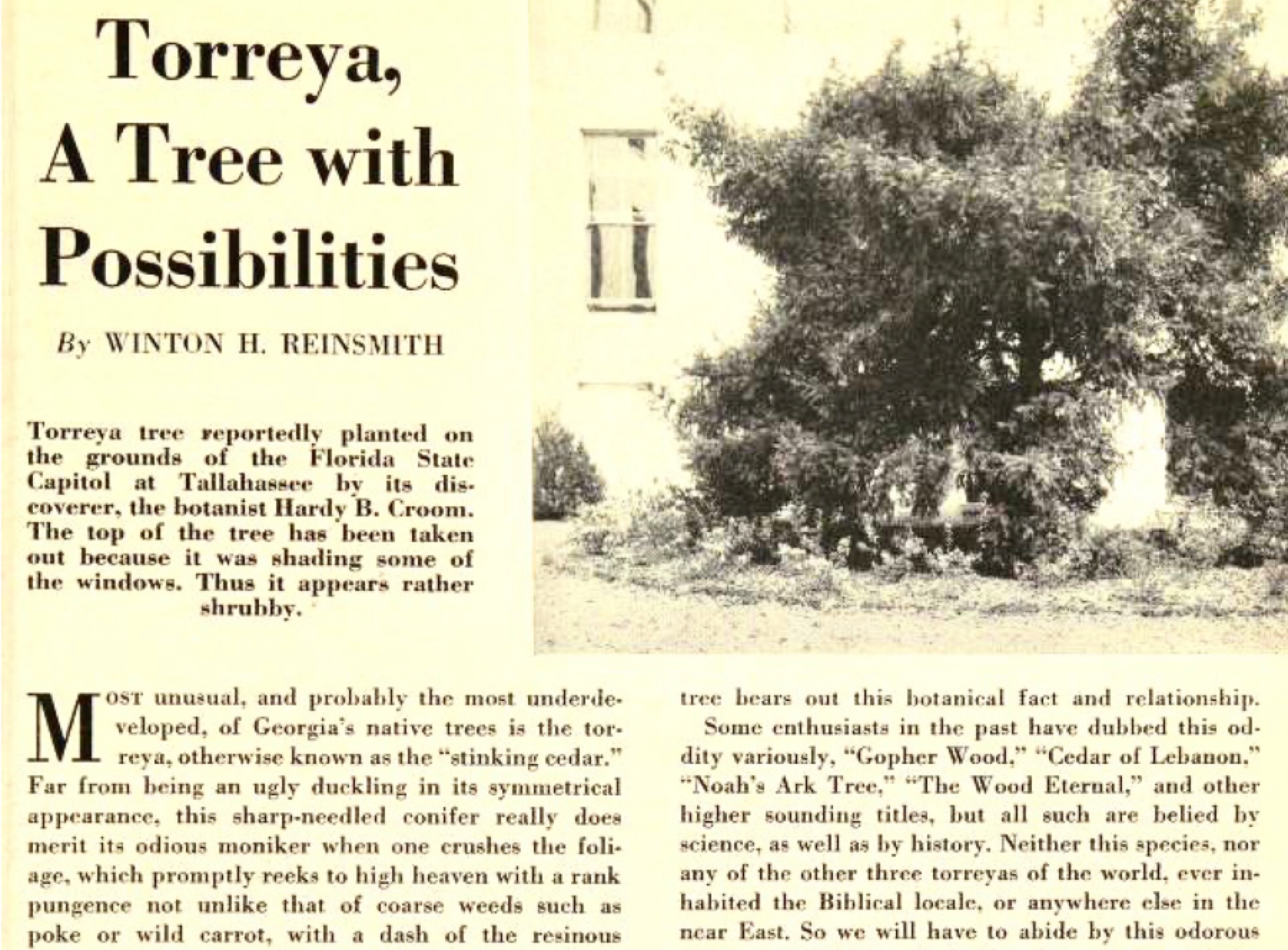
|